ResourceWork & Money
How to Ask for a Raise (Even If You Hate Asking)
A plain, practical guide to checking your pay, building your case, and saying the number out loud.

Most advice about asking for a raise assumes you are comfortable asking. You read the confident script, you picture yourself saying it, and your stomach drops.
This is the version for the rest of us. It starts with proof, not confidence, because evidence is what carries you through the part where your voice shakes.
And if you are a woman, there is one more thing worth knowing before you start. The old line that women earn less because they do not ask is mostly a myth. A study of 4,600 workers found women ask for raises as often as men. They just hear yes less often: 15 percent of the time, against 20 percent for men. So this guide is not about finding your courage. It is about making your case so well that it is hard to turn down.
Negotiating a new job offer instead of a raise? Start with how to negotiate salary.
First, Check If You Are Underpaid
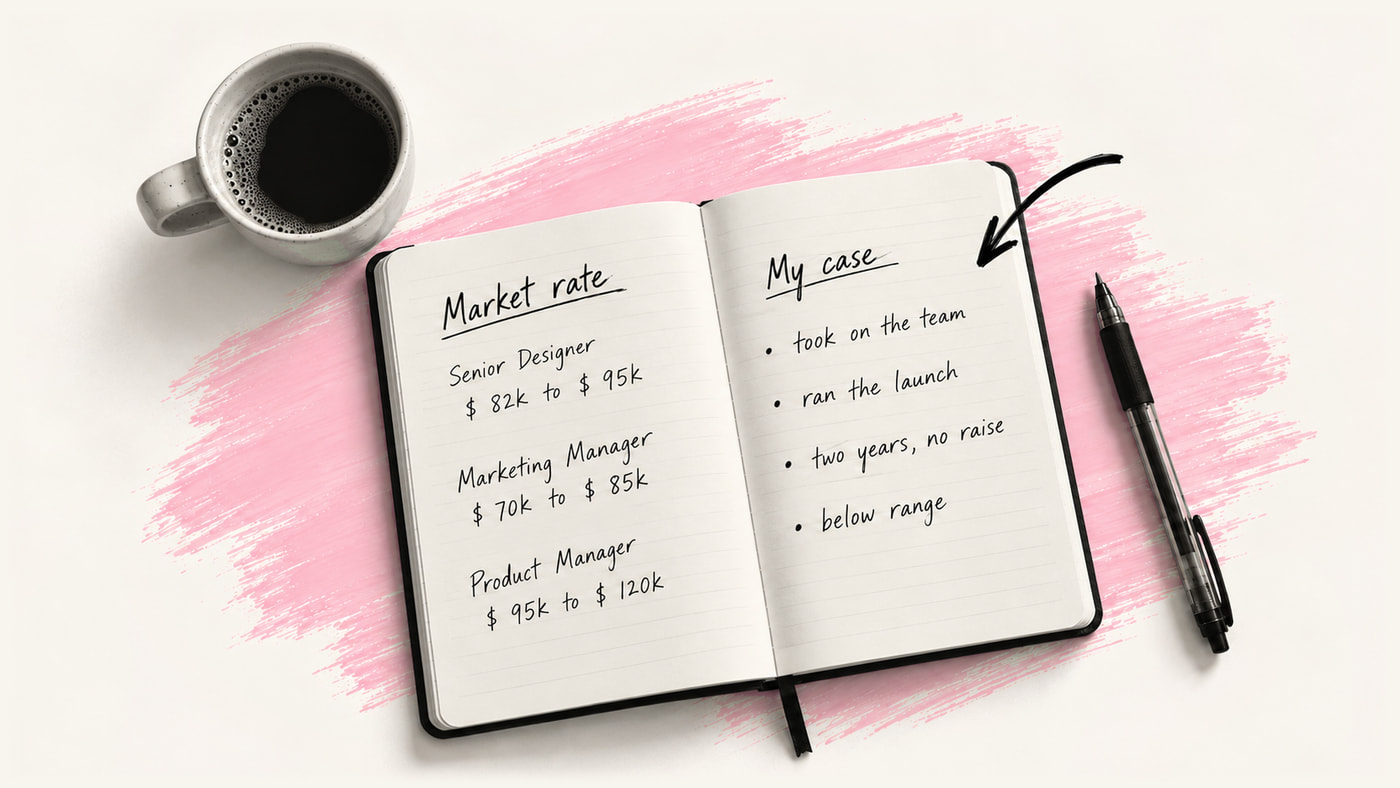
Before you ask for anything, find out what the job pays elsewhere. Not what you feel you deserve. What the market pays someone doing your work.
Three places to look:
Job ads for your own title. Many US states now require employers to post salary ranges, so search your title and city as if you were applying. Read ten ads and you will see the band.
Salary sites. Glassdoor, Levels.fyi for tech, Payscale, and the Bureau of Labor Statistics for a sanity check. Each is rough on its own. Together they give you a range.
People. Recruiters will tell you what they are placing people at, and they will take your call even when you are not looking. Former colleagues at other companies are often more open than current ones.
Now write down two numbers. Your target, which is the top of what the evidence supports. And your floor, which is the number below which you would start looking elsewhere. You never say the floor out loud. You just need to know it.
If the research shows you are paid fairly, that is still useful. It changes the conversation from pay to scope, and a bigger role is usually how the next pay jump happens anyway.
There is also a gap the job ads will not show you. In 2025, women working full time in the US earned 84 cents for every dollar men earned, according to the Census Bureau. Measured against white, non-Hispanic men, Black women earned 64 cents and Hispanic women 60, according to an analysis of the same data by the Center for American Progress. If you suspect you are paid less than a man doing the same job, ask him. Use his number to set yours, not as a line in the meeting. In the US, most private sector employees are legally protected when they talk about pay with each other, even if the company says salaries are confidential.
Build Your Case Before You Pick Your Moment
Managers rarely have the power to say yes on the spot. Most are asking someone above them, with a budget set months earlier. Your job is to hand them the argument they will repeat in that meeting.
Three reasons tend to work:
You are doing a bigger job than the one you were hired for. List what you own now that you did not own a year ago.
Your results are measurable. Revenue, retention, time saved, projects shipped, people trained. Write the numbers down, even rough ones.
Your pay is below the market rate. This is where the research earns its place.
Three reasons tend not to work: time has passed, your rent went up, and someone else earns more. The first two are about you rather than the work. The third turns the conversation into a complaint about a colleague instead of a case about you.
On timing, aim for the weeks before budgets are set rather than after they are locked, which often means a couple of months ahead of the review cycle. Just after a visible win is good. During layoffs or a bad quarter is not, though if you are underpaid and carrying extra work, waiting for a perfect moment that never comes is its own kind of answer.
Ask for the meeting in advance, in one line. Something like: "Could we find thirty minutes this week to talk about my role and compensation?" Nobody should walk into this conversation surprised, including you.

“You are not asking for a favour. You are asking for the rate.”
What to Say When You Ask
Keep it short. Four beats, then stop talking.
Open with the ask. "I would like to talk about my salary. Based on my work this year and what the market pays for this role, I am asking for an increase to X."
Give the evidence. Two or three specifics, not ten. The expanded scope, the results, the market range.
Name the number. Not a range. Ranges get read as the lowest number in them.
Then be quiet. The silence will feel endless and it is doing work. Let them fill it. You are not asking for a favour. You are asking for the rate.
A few things not to say. Do not apologize for asking. Do not open with "I feel like". Do not bluff about an offer you would not take, because people take that bluff. And do not name a colleague's salary, which moves the subject to them and away from you.
Is asking for a 20% raise too much?
It depends on where you are starting. An internal raise for the same role is usually in the 5 to 10 percent range. Asking for 10 to 20 percent is reasonable when your research shows you are well below market, or when you have taken on a genuinely bigger role. The number is only as strong as the evidence behind it.
Is a 3 percent raise really a raise?
It is roughly a cost of living adjustment at best. If you were underpaid before, 3 percent keeps you underpaid.
What if they say no?
Do not argue and do not fold. Ask the only question that matters: "What would need to be true for this to be a yes?" Push for specifics and a date. Which results, which scope, which month we revisit. Then send a short email summarising what you agreed, so it exists in writing. A no with a defined path is a delay. A no with nothing attached is information about your employer, and worth taking seriously.
What if your manager gets defensive?
Let it pass. Say "that is fair" and return to the question of what would change the answer. You are not trying to win the exchange. You are trying to leave with a number or a date.
What if I worry about coming across as pushy?
That worry is not in your head. Research has found that women who negotiate are more likely to be judged as demanding than men who say the same words. The answer is not to ask for less or wrap the number in apologies. It is to lean harder on evidence. Tie the ask to your results and the market rate, so the conversation is about the job and the numbers, not about you. Calm and specific is hard to call pushy.

How to Ask for a Raise by Email
Email is the better route when your manager is remote, when they think better in writing, when you want a record, or when saying it out loud is the thing stopping you entirely. An email that gets sent beats a conversation you keep postponing.
After the meeting, send one more line confirming whatever was agreed, including the date you will revisit it. Written beats remembered.
Final Thoughts
One last thing. You are allowed to ask without being certain, without a perfect script, and without feeling confident. Asking badly and getting paid properly beats waiting until you feel ready.
And if you are doing this while running on empty, rest is part of the work too.