Self & Relationships
How to Recover From Burnout While Still Working: A Plan
You cannot quit and you cannot stop. Here is how to get your energy back anyway: cut scope at work, hand half the home load back, and rest in the gaps.

You are burnt out and you still have to log on tomorrow. Nobody is offering a sabbatical. You can recover from burnout while still working, but not by squeezing more rest into gaps you do not have. You recover by making the load smaller. This week, cut one thing at work and one at home, protect your sleep, and start the conversations that change who carries what.
What Burnout Looks Like When You Cannot Stop
The World Health Organization describes burnout as a syndrome resulting from chronic workplace stress that has not been successfully managed, with three dimensions: exhaustion, growing mental distance or cynicism about your job, and reduced professional efficacy. It calls burnout an occupational phenomenon, not a medical condition. In our view the fix is in the conditions, not in you.
If you feel hopeless or have thoughts of harming yourself, call or text 988 in the US, free and confidential at any hour, and talk to a doctor or therapist. This guide describes patterns, not diagnoses.
What does burnout feel like? According to Mental Health America, exhaustion no matter how much you rest, dreading responsibilities you once enjoyed, and making more mistakes than usual.
How do I tell if I am burnt out? Check the three dimensions. In our view, exhaustion alone could be a hard season. Exhaustion plus cynicism plus the sense that you are no longer good at this fits the WHO description of burnout. See a doctor to rule out anything medical that feels similar.
What are the 7 signs of burnout? Mental Health America lists six: constant exhaustion no matter how much you rest, dreading responsibilities you once enjoyed, feeling detached or emotionally numb, struggling to focus or making more mistakes, feeling irritable or overwhelmed more often than not, and frequent physical symptoms such as headaches or muscle tension.
What are the 12 stages of burnout? Freudenberger and North divided burnout into twelve phases, from the compulsion to prove oneself to a final phase they simply called burnout. The review in Frontiers in Psychiatry notes that different versions of the stage order exist.
Why It Lands Harder on Women
Our shorthand for the general recipe is too much, for too long, with too little say over it. The gendered part is what counts as too much, because for many women the day does not end when the laptop closes.
The 2025 American Time Use Survey found 87 percent of women and 75 percent of men did household activities on an average day, and on those days women spent 2.8 hours to men's 2.1. Among employed adults whose youngest child is under six, women spent 2.04 hours a day caring for household children and men 1.39. That is 0.65 hours, or 39 minutes a day, about four and a half hours a week. Those hours sit next to mom guilt.
Work adds a layer. Linda Babcock and colleagues found that women, more than men, volunteer for tasks with low promotability, are asked more often and accept more often: the committee seat, the report nobody wanted to write. Caregiving in the US 2025 found three in five family caregivers are women. And Women in the Workplace 2025 reports six in ten senior level women frequently feel burned out, compared with about half of men at their level and about four in ten employees overall.
Name the pattern, not the person. In our view the pattern is that the extra load is invisible, so nobody renegotiates it until you do. If tasks at home get done so badly they come back to you, that is weaponized incompetence.
Rest without renegotiation refills a bucket with the same hole in it.
How to Recover From Burnout While Still Working
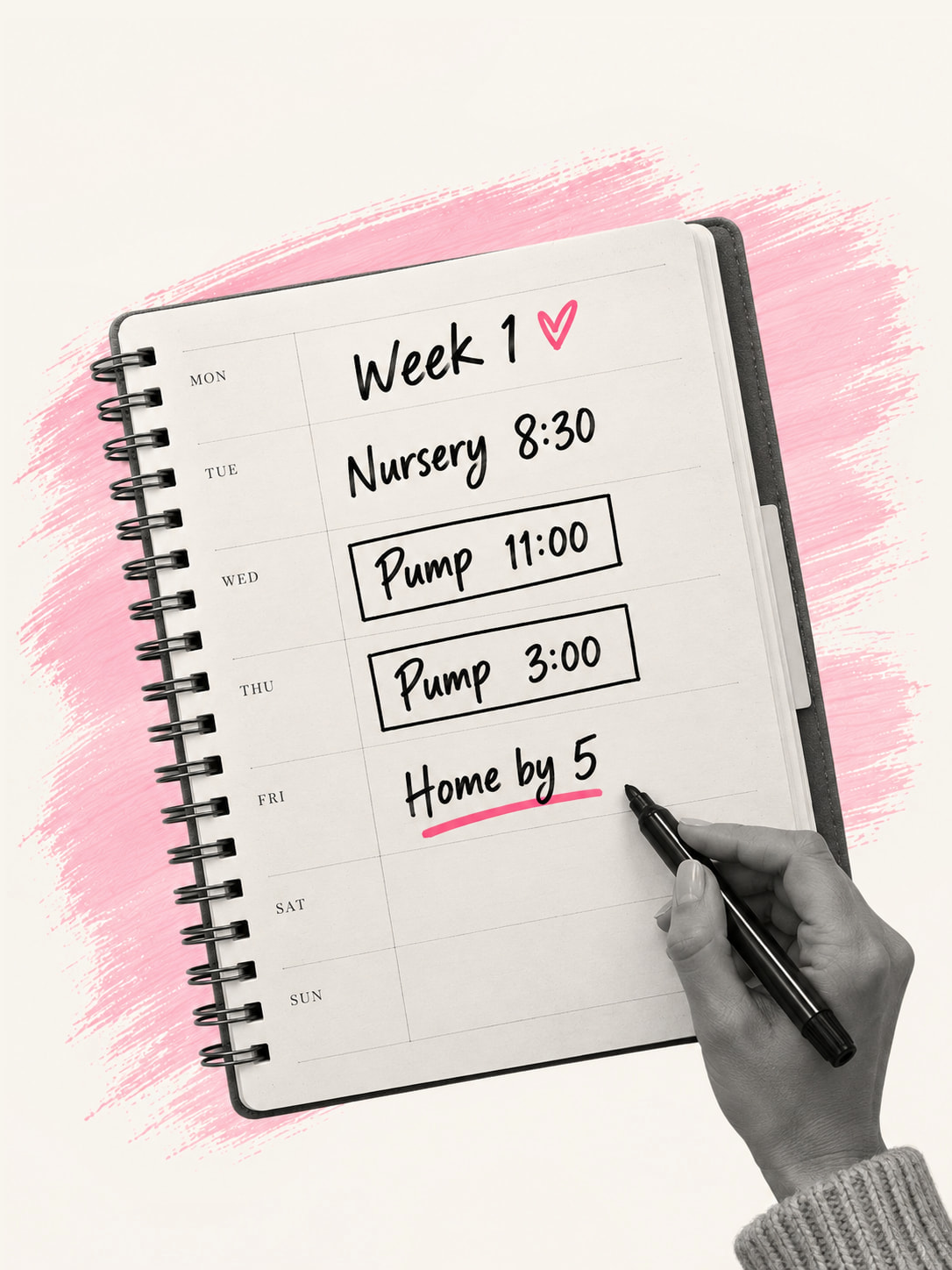
The first week lowers the load. The first month changes who carries it.
Week one:
- Cut one thing at work. Pick the one that costs you most and advances you least.
- Cut one thing at home. Not delegate. Hand it over, from noticing to done.
- Sleep before anything else.
- Book one rest slot that is yours, thirty minutes, in the calendar.
- Stop the non promotable yeses. For seven days, "let me check and come back to you" is your only answer.
Month one:
- Renegotiate scope with your manager as a choice between two things they want, not a confession. Boundaries at work covers how to hold the line.
- Hand whole items back at home with ownership attached, including the remembering.
- Use the supports that exist: your doctor, a therapist, an employee assistance programme if your employer has one. Under the Family and Medical Leave Act, eligible employees of covered employers can take unpaid, job protected leave for a serious health condition, up to 12 workweeks in a 12 month period, sometimes in separate blocks. Ask HR, a union or an employment lawyer whether it applies to you.
- Rest in the gaps instead of waiting for a holiday. Twenty minutes with your phone in another room counts.
What is the 42% rule for burnout? It comes from Emily and Amelia Nagoski's book Burnout. Amelia Nagoski explains that it adds up eight hours of sleep, 45 minutes of physical activity, a 20 minute nap, short breaks and time using your mind differently from your main work: about ten hours, or 42 percent of a day (0.42 times 24 hours is 10.08). She calls the number distilled from a wide body of research on rest and sleep, not one study.
How long does burnout typically last? Cleveland Clinic psychotherapist Natacha Duke says recovery can take anywhere from a few months to a few years and depends on multiple factors. In our view the biggest factor is whether the load actually changes. Rest without renegotiation refills a bucket with the same hole in it.
What to Say
Keep the shape: a trade off, not an apology.
To your manager:
"I want to do the launch and the quarterly report well, and right now I cannot do both. Which one comes first, and can the other move to next month or to someone else?"
The email version:
"Hi [name], I have [A] and [B] due the same week. To deliver [A] properly I would like to push [B] to [date] or hand it to [colleague]. Which do you prefer?"
To your partner:
"I am running on empty and I need to change what I carry, not just get help with it. From this week, can bedtime be yours, start to finish, including the remembering? I will not step in."
To family or a friend:
"I can't take that on right now. I would love to see you next month instead."
Every one of those is a no with a door left open, the same shape as saying no without guilt.
Pick one thing at work and one at home this week and hand them back. Then protect your sleep for seven nights. You are not failing at coping. You are carrying more than one person's share, and rest is part of the work too.
Key Takeaways
More on Self & Relationships
View All
How to Say No Without Guilt: Scripts for Work and Home
5 min read

Mom Guilt: Why It Hits So Hard and How to Put It Down
5 min read

How to Set Boundaries at Work (and Make Them Stick)
5 min read
Explore more resources and keep learning with us.
Browse All Resources