
ResourceWork & Money
Returning to Work After Maternity Leave: A Real Guide
How to plan your first weeks back, know your rights, and ease into work again without losing yourself or your mind.
The bag is packed, the childcare is sorted, and you have checked the bottles three times. And somewhere in the middle of all that, you are wondering whether you still know how to do your job, whether anyone will notice you have been gone, and whether you are allowed to cry in the car park.
Returning to work after maternity leave is one of the biggest transitions there is, and most workplaces treat it like a normal Monday. It does not have to feel that way. With a bit of planning, a clear sense of your rights and some patience with yourself, the first few weeks can be a lot gentler.
Before You Go Back: Make a Plan
The return starts before your first day. A few things to sort out while you are still on leave:
- Talk to your manager two to four weeks before you come back. Ask what has changed, what your first projects will be, and who you should catch up with.
- Ask about a phased return. Some employers will agree to shorter days, a shorter first week or starting midweek. It never hurts to ask.
- Do a trial run of childcare. A few hours or a full day before you go back takes the pressure off the real first morning.
- Practise the morning. Get everyone up, dressed and out the door at the real time at least once. You will find the problems before they make you late.
- Plan your pumping, if you are breastfeeding. Know where you will pump, how often, and where you will store milk.
None of this has to be perfect. It just has to mean that day one is not also the day you figure everything out.
Know Your Rights at Work
You have more protection than many people realise, and knowing it makes the conversations easier. In the US, three laws matter most.
The Family and Medical Leave Act gives you up to 12 weeks of unpaid, job protected leave if your employer has 50 or more employees and you have worked there for at least 12 months and 1,250 hours in the past year. When you come back, you have the right to the same job or an equivalent one.
The Pregnant Workers Fairness Act requires employers with 15 or more employees to make reasonable accommodations for pregnancy, childbirth and related conditions. That can include things like a modified schedule while you recover.
The PUMP for Nursing Mothers Act gives most employees the right to reasonable break time to pump for up to one year after the baby's birth, in a private space that is not a bathroom.
A growing number of states also offer paid family leave on top of these, so check what applies where you live. Whatever you agree with your employer, get it in writing. Laws change and the details vary, so if something does not feel right, HR or the Department of Labor can help.
How to Handle the First Weeks Back
Expect a ramp up. You will not be at full speed on day one, and you do not need to be. Give yourself two to four weeks to catch up, and tell your manager that is the plan.
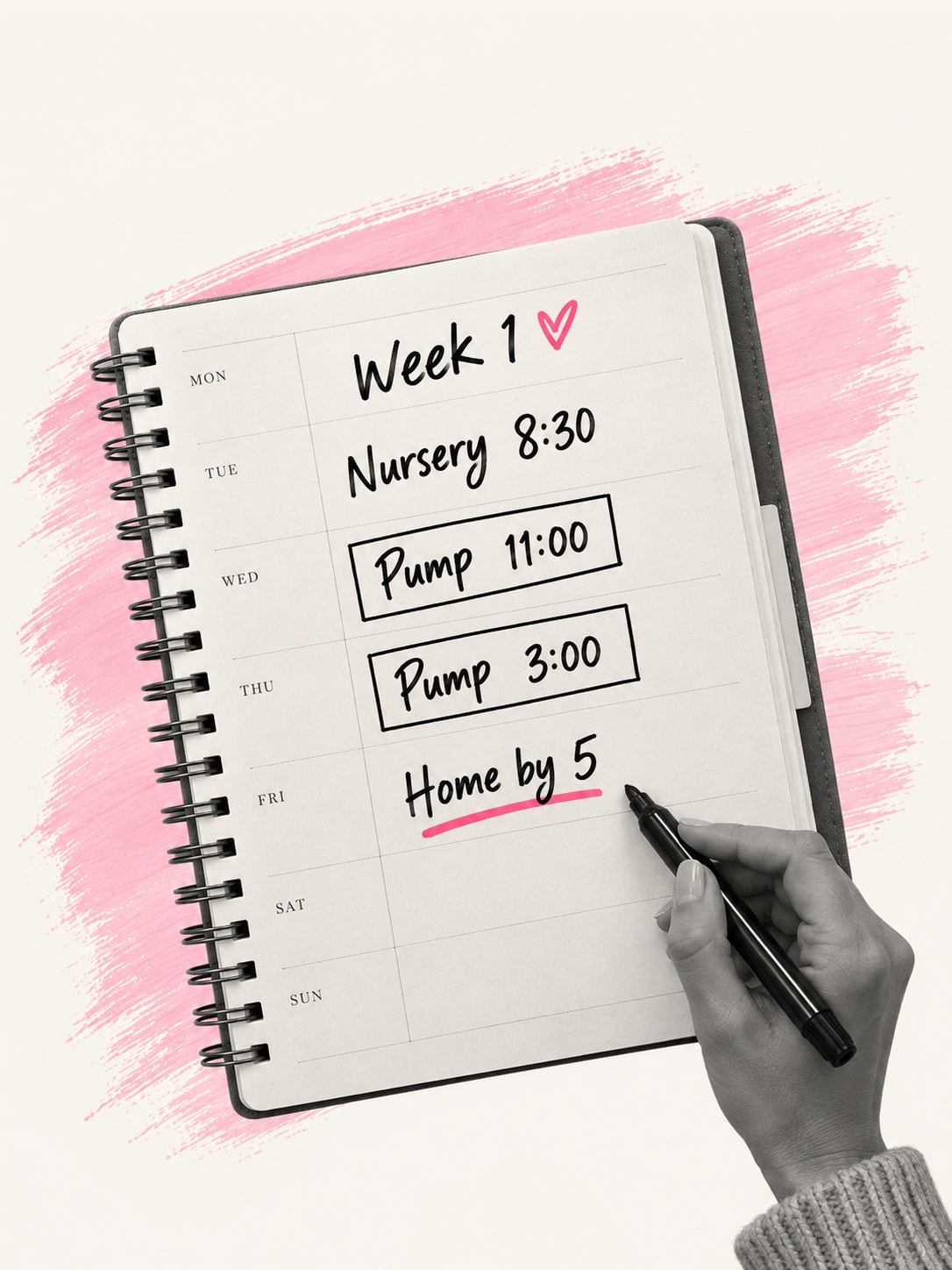
Protect your pumping time. Block it in your calendar like a meeting. If a meeting runs into it, step out. This is not a favour. It is your legal right.
Make your work visible. Unfortunately, the motherhood penalty is real. Shelley Correll and colleagues found that mothers were recommended lower starting salaries than equally qualified women without children, while fathers were not penalised, and sometimes benefited. The best counter is evidence. Share early wins, update your manager on what you have delivered, and keep a running list.
Learn to say no. You have less time than before, so guard it. Saying no to the extra committee is how you make space for the work that matters and for getting home on time.
Share the load at home. If your partner suddenly does not know how to pack a nappy bag or book a doctor's appointment, that is weaponized incompetence, and it is worth dealing with now, before the pattern sets.
How do I tell my boss I need to pump?
Keep it simple and practical: "I am breastfeeding, so I will need two or three short breaks a day to pump. Where is the best private space for that?" You do not need to explain more than that.
Can my employer change my role after maternity leave?
If you are covered by the FMLA, you have the right to return to the same job or an equivalent one, with the same pay and benefits. If your role has changed in a way that feels like a demotion, ask for the reason in writing and speak to HR.
Is it normal to feel guilty or cry when going back to work?
Very. Most new mothers feel some mix of guilt, relief, sadness and excitement, often in the same hour. But if you feel persistently low, hopeless or anxious for more than a couple of weeks, talk to your doctor. Postpartum depression is common and treatable.
What if I do not want to go back?
That is a real option to explore, not a failure. Before you decide, look at part time, flexible or remote arrangements, and talk through the money honestly. Some women find the answer is a different job, not no job.

What to Say: Scripts for Your Return
Short, clear and confident. You are not asking for special treatment.
With your manager
Before you come back
"I am looking forward to coming back on the 4th. Could we have a quick call the week before so I know what to expect?"
When you want a phased return
"Would you be open to a phased return? I was thinking shorter days for the first two weeks."
When you need pumping time
"I will need two short breaks a day to pump. I will block them in my calendar so they do not clash with meetings."
With your team
When someone asks if you are ready
"I am glad to be back. I am catching up this week, so I would love a quick summary of where things stand."
When a meeting runs into pumping time
"I need to step out for my break now. I will catch up on anything I miss."
When you need to leave on time
"I am heading out at five today. I will pick this up first thing tomorrow."
Pick the two you will need first and use them in your first week.
“You are not starting over. You are coming back.”
Final Thoughts
You are not starting over. You are coming back. The skills you had before your leave are still there, and you have added patience, prioritising and running on very little sleep. Give yourself time, ask for what you need, and let the first weeks be a little messy.